

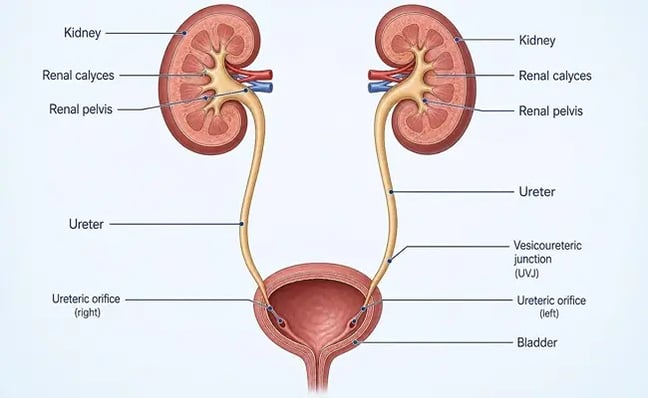
Vesicoureteral reflux, or VUR, means urine travels backwards from the bladder towards a kidney through a ureter. It may affect one or both sides. The name can sound alarming, but children have very different risks. Assessment focuses on preventing serious urinary infections and protecting kidney health while deciding whether reflux is likely to improve with growth.
Why the direction changes
Normally, each ureter carries urine from a kidney to the bladder, and its passage through the bladder wall helps prevent backward flow. In primary VUR, this valve mechanism has not developed effectively. Secondary reflux can be linked to difficulty emptying the bladder or raised bladder pressure. The diagnosis is not caused by ordinary parenting, and families cannot determine the mechanism from symptoms alone.
How does it come to attention
Some children are investigated after a urinary tract infection with fever. Others have urinary tract dilatation identified before birth or during another assessment. Reflux itself may cause no obvious discomfort. In babies, infection can present as fever, poor feeding, vomiting, or unusual irritability. Older children may describe painful urination, abdominal or back pain, urgency, or new accidents. These symptoms deserve medical advice, not automatic attribution to teething or toilet training.
What the tests answer
Ultrasound shows kidney growth and the appearance of the urinary tract, but a normal scan does not exclude reflux. A specialist may recommend a bladder contrast study, often called MCUG or VCUG, using a small catheter and imaging during filling and urination. Reflux is graded from one to five. Selected children need other tests to assess kidney tissue or function; every child does not need every investigation.
A grade is only part of the picture
The clinician also considers age, previous fever-associated infections, kidney findings, and bladder and bowel habits. Constipation and incomplete bladder emptying can make infection prevention harder. Some mild reflux improves naturally; other children need closer monitoring, preventive antibiotics, or a procedure. Ask for an explanation of the individual risk rather than treating a grade alone as a prediction of future kidney health.
Preparing for follow-up
Keep a record of confirmed infections, urine culture results, imaging, and medicines. Agree on where a urine sample should be checked when fever has no clear cause, and who will review the results. Fever in a young infant, or fever with vomiting, marked lethargy, poor intake, or reduced urine, needs urgent assessment. A child taking preventive antibiotics can still develop an infection and needs review when unwell.
Your child's next step
A consultation through DRHC with Dr. Mansour Masoumi, Specialist Urologist, can help clarify your child’s findings and arrange the appropriate paediatric specialist pathway. Bring previous reports and a list of your questions. The final treatment is chosen after individual assessment, with the child’s age, symptoms, and family circumstances taken into account.
Disclaimer
This article is educational and does not replace a medical consultation. Do not use it for self-diagnosis or self-treatment, or to start, stop, or change your child’s medicines. Follow the advice from the clinician responsible for your child’s care.

Learn more about our Editorial Process.
Topic: Urology Blogs





Leave a comment