

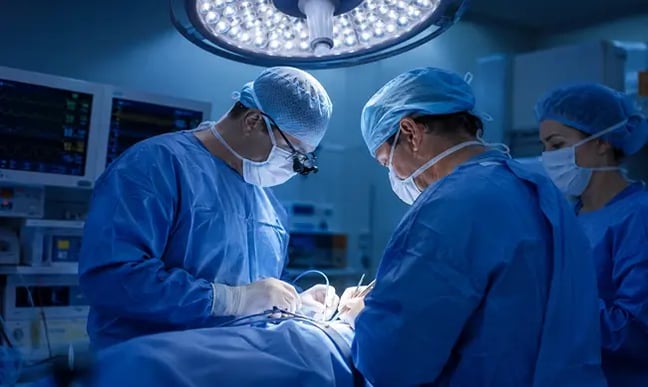
Surgery for Peyronie's disease aims to make the penis straight enough for comfortable sexual function. It cannot promise to restore its exact earlier appearance or length. The choice between plication, grafting and a penile prosthesis depends on the deformity and erection quality. A useful consultation starts with the difficulty you want to solve rather than a request for a named operation.
Establish that the condition is stable
Surgery is generally considered once the curvature has stopped changing and the deformity compromises intercourse. Operating while the condition is still evolving can undermine the result. The surgeon reviews the history, current shape, penile dimensions and erections, including the response to erection medicines. Explain narrowing, buckling, and shortening as well as the bend. These features can change which reconstruction is suitable and what trade-offs need discussion.
Plication balances the longer side
Plication and related shortening techniques make the longer side of the erectile covering shorter to reduce the bend. They are often considered when erection firmness and available length are adequate, and the deformity is less complex. Shortening and palpable stitches are relevant issues to discuss. The goal is usable straightness rather than a completely featureless appearance, and a small residual curve may be compatible with satisfactory function.
Grafting addresses selected complex deformities
An incision in the tight area can release the curve, with a graft covering the resulting defect. This may suit selected severe or complex deformities when erections are sufficiently reliable. It is not a guarantee of gaining length. The operation can affect erection quality and sensation, so the surgeon must assess those concerns carefully. Ask why grafting is preferred for your anatomy and how its risks compare with shortening techniques.
A prosthesis treats significant erection failure
When erectile dysfunction does not respond adequately to other treatments, a penile prosthesis may address rigidity as well as support the correction of curvature. Additional straightening manoeuvres can be required. This is an operation with long-term device considerations, including infection, mechanical problems, and possible revision. It is different from cosmetic implants or fillers, and should be chosen for the assessed functional problem with clear expectations about device use.
Prepare for recovery and review
Clarify anaesthesia, wound care, pain relief, any foreskin procedure, and the time away from work and sex. Use traction or postoperative exercises only if your surgeon prescribes them. Bruising, swelling, and altered sensation need an explained recovery plan; fever, wound discharge, or worsening pain requires prompt contact. Longer-term review considers intercourse, erections, and satisfaction as well as the angle. Residual or recurrent curvature remains possible after any approach.
Discuss your next step
A consultation with Dr. Mansour Masoumi, Specialist Urologist, through DRHC can help you compare the evidence, practical burden, and realistic aims of suitable non-surgical approaches. The final treatment is chosen after an individual assessment and discussion of your preferences. Bring previous results and a medicine list so the advice can be based on your own circumstances.
Disclaimer
This article is for education and does not replace a medical consultation. Do not use it for self-diagnosis or self-treatment, or to start, stop, or change medicines. Your doctor should guide care after considering your symptoms, medical history, and individual circumstances.

Learn more about our Editorial Process.
Topic: Urology Blogs





Leave a comment