

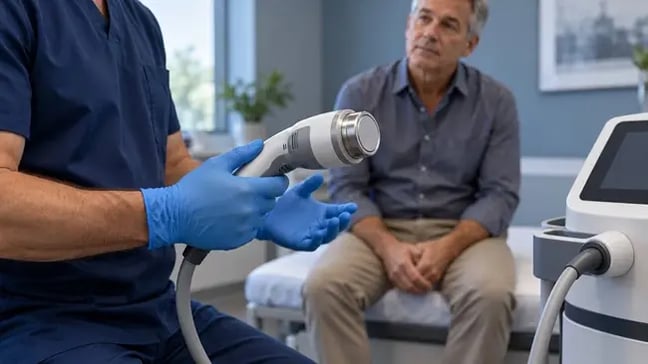
Low-intensity shockwave therapy is often discussed by men looking for a non-surgical treatment for erectile dysfunction. During treatment, a device applies pulses of energy to areas of the penis. The idea is to encourage changes in the blood vessels involved in erections. It is worth understanding what this treatment can offer before deciding whether to include it in your care.
Who is it usually discussed with?
The strongest interest is in men whose erection difficulty is related to blood flow, sometimes called vascular ED. It is not a general solution for every cause of erectile difficulty. For example, a treatment aimed at blood vessels may not address low sexual desire, significant hormonal problems or anxiety on its own. An assessment helps establish whether your symptoms fit the group being considered.
What does a visit involve?
Treatment is usually delivered in an outpatient setting without an operation or injections. The clinician places a handpiece against the skin using a coupling gel. A course typically involves several visits, but schedules vary between devices and protocols. Ask what equipment is being used and what the proposed plan involves rather than assuming all treatments called shockwave therapy are identical.
What does the evidence tell us?
Some studies show a modest improvement in erections in selected men, while others show less benefit. Professional guidelines take different positions: European guidance allows consideration in selected patients, whereas American guidance describes it as investigational. This difference is a reason for a clear discussion, rather than a promise of a cure. The evidence for one machine or treatment schedule cannot automatically be applied to another.
Shockwaves and acoustic waves are not interchangeable
Advertisements may use terms such as acoustic waves, radial waves and focused shockwaves as if they mean the same thing. The technology and supporting research can differ. Ask your doctor to explain which treatment is being proposed and why it is suitable for your situation. The name of a package alone does not tell you how well it has been studied.
Keep the bigger picture in view
Even if shockwave treatment is considered, controlling diabetes, addressing smoking, and reviewing cardiovascular health remain important. Some men continue, prescribed ED tablets as part of their plan. There is no need to stop effective medication simply because a course is being started. A useful follow-up discussion focuses on whether erections and everyday sexual function have improved, not only on a scan or questionnaire score.
A consultation before committing to a course
Bring information about treatments you have tried and what you found helpful or inconvenient. It is also reasonable to ask about the total number of visits, costs, and how progress will be assessed. Dr. Mansour Masoumi, Specialist Urologist, can discuss shockwave therapy and other ED approaches through DRHC. Your final treatment plan should follow a full assessment and an explanation of the available evidence in terms that make sense to you.
Disclaimer
This article provides general information only and does not replace a medical consultation. Do not use it to diagnose yourself, choose a procedure, or start, stop, or change treatment. Decisions about your care should be made with your doctor after an individual assessment.

Learn more about our Editorial Process.
Topic: Urology Blogs



Leave a comment